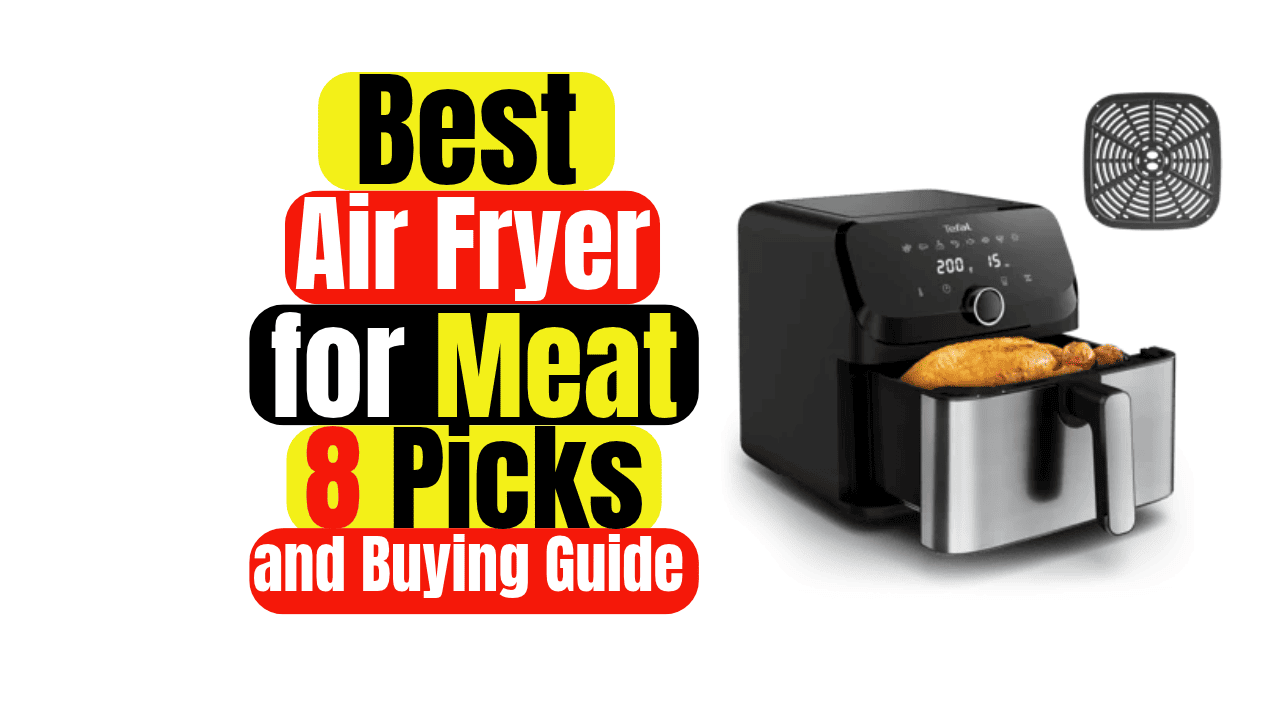
The best air fryer for meat has at least 1,500 watts, a wide cooking surface, reliable temperature control up to about 400 °F (200 °C), easy-clean parts and, ideally, an air fryer with temperature probe. Dual basket air fryers suit most households, while an air fryer oven suits whole chickens and big roasts.
That is the short version. This guide explains why those features matter, which type fits which meat, and how to cook safely once you own one.
From my experience: I have used the models covered here, so I look past headline capacity and preset counts. With meat, what matters day to day is usable basket space, whether pieces fit in one layer, how easy it is to flip and check food, how grease is collected, and whether the controls help with doneness. A roomy basket or a reliable thermometer beats a long feature list.
Which Air Fryer Models Suit Meat Best?
No single model wins for every cook. Choose by the meat and the household: a big single basket for family batches, a dual zone air fryer for two meats at once, an air fryer toaster oven for roasts, or a probe-equipped model for steak.
The eight models below are compared by usable cooking space, heat range, layout, doneness tools, cleaning and the meats they suit. Check the exact version, voltage and warranty where you buy, because regional versions often carry different model codes.
Which Model Fits Which Buyer?
- Large family, simple cooking, tight budget: Tefal Easy Fry Mega.
- Two foods that must finish together: Philips 5000 Series.
- Whole chicken, ribs or roasts: Breville Smart Oven Air Fryer Pro.
- Steak and a crisp crust for 3–4 people: Typhur Dome 2.
- Probe-guided doneness: Dreo ChefMaker.
- Grill-style steak and burgers: Ninja Foodi MAX.
- A dependable first air fryer: Instant Vortex Plus 6-Quart.
- Presets and a large basket: Philips Premium Airfryer XXL.
Tefal Easy Fry Mega EY855D40
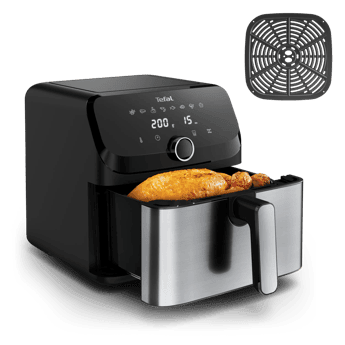
Suits families who want a large basket-style air fryer without a premium price. It is a 7.5 L single-basket countertop air fryer that serves up to eight people.
- Key features: 8 presets, a dishwasher-safe nonstick basket, 80–200 °C and a 60-minute timer. Listed power varies from about 1,700 to 2,020 W. The UK listing shows a 2-year guarantee.
- Advantages: Large capacity in a compact footprint, easy to clean, solid build.
- Limitations: The 200 °C ceiling sits just under the 400 °F target. No probe and only one cooking zone.
- My experience: Great when you spread chicken pieces out; if you fill it edge to edge, browning gets uneven.
- Best for: Families cooking chicken thighs, wings, burgers and sausages in one layer. Keep an instant-read thermometer nearby.
Breville Smart Oven Air Fryer Pro BOV900BSS
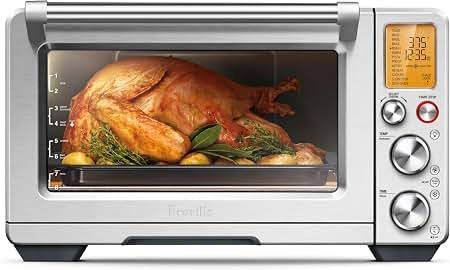
Suits cooks who roast whole chicken, large cuts or several trays at once. It is an air fryer oven with a 1 cu ft interior and 1,800 W.
- Key features: 13 cooking functions, Element IQ heat control, super convection fan, two racks, an air-fry mesh basket, a roasting rack and a 13-inch pizza pan. The US warranty is 2 years.
- Advantages: Room for large roasts and multiple levels. It bakes, roasts, dehydrates and slow cooks, and can replace a toaster oven.
- Limitations: It needs a lot of counter space and costs more than most basket models. Drawer-style baskets generally air-fry better, so this is a roasting tool first.
- My experience: Think of it as a compact oven with air-fry capability. Rotate food, because multiple racks do not brown identically.
- Best for: Whole birds, ribs, roasts, large gatherings, or anyone wanting one appliance for oven and air-fryer jobs.
Instant Vortex Plus 6-Quart
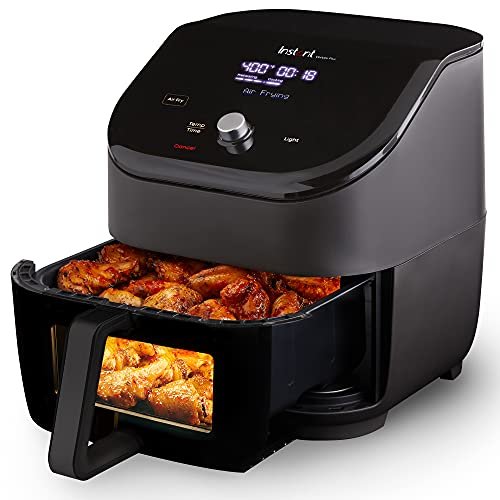
Suits couples and small families who want a dependable all-rounder at a mid-range price. It is a 6 qt (5.7 L) digital air fryer rated at 1,700 W.
- Key features: Six programs (air fry, bake, broil, dehydrate, reheat, roast), EvenCrisp technology, a dishwasher-safe nonstick basket and a 1-year limited warranty. Some versions add a viewing window and OdorErase, so check the listing.
- Advantages: It holds a 4 lb chicken and offers more modes than the original Vortex.
- Limitations: One basket, no built-in probe, bulky body.
- My experience: Simple, familiar controls, but you still need gaps between pieces and a thermometer for thick cuts.
- Best for: First-time buyers cooking thighs, pork chops and burgers for two to four people.
Philips Premium Airfryer XXL HD9870
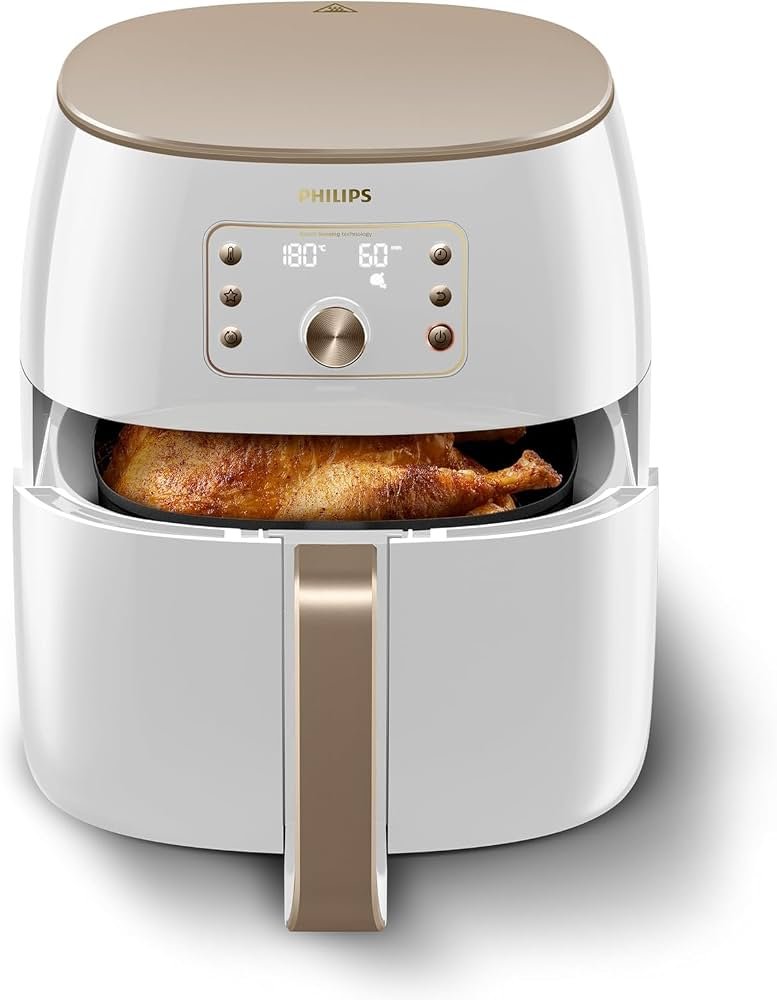
Suits families who want automatic presets and a large single basket. Its 7.3 L basket handles a whole chicken or up to 1.4 kg of fries.
- Key features: Smart Sensing technology that adjusts time and temperature by food type, Fat Removal and Rapid Air technology, Keep Warm mode and QuickClean dishwasher-safe parts. One retailer lists 2,225 W and a 2-year warranty, with a meat program.
- Advantages: Presets reduce guesswork, and the fat-removal system drains fat from foods like chicken drumsticks.
- Limitations: No built-in probe. Some pages show it as unavailable, so confirm stock and warranty. Presets are not a food-safety check.
- My experience: Handy for familiar foods, but chicken legs and burgers of different sizes finish at different times, so always check the internal temperature.
- Best for: Families cooking chicken legs, burgers and sausages in bulk who like set-and-forget cooking.
Philips 5000 Series Dual Basket Airfryer NA555/09
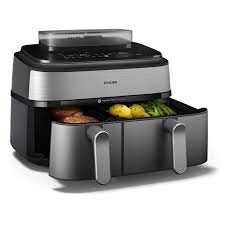
Suits households that cook two foods at once, such as a steak and a side. It is a dual basket air fryer with about 9 L total capacity and 2,750 W.
- Key features: Two independent zones with a sync-finish setting, steam in one basket, 11 presets, dishwasher-safe parts and a 2-year guarantee. Range is 40–200 °C, up to 60 minutes. The zones are different sizes.
- Advantages: Two meats, or meat and a side, finish together. Steam helps keep delicate cuts tender. Philips claims up to 90% less fat than traditional frying.
- Limitations: Large (about 40 × 49 × 39 cm) and premium priced. The 2,750 W draw is high, so check your socket. Steam means descaling, and there is no built-in probe.
- My experience: The workflow is the real benefit. Check that the smaller basket suits your usual portions before buying.
- Best for: Families cooking full meals and weeknight dinners where timing matters.
Typhur Dome 2 Air Fryer
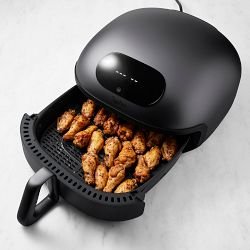
Suits cooks who value browning and a wide single layer over sheer capacity. It is a flat, wide 5.6 qt (5.3 L) air fryer with 1,750 W.
- Key features: Heating elements above and below the food (top and bottom heat), 105–450 °F, a ceramic-coated basket, self-cleaning function, 15 functions and room for a 12-inch pizza. Listings show a 1-year limited warranty.
- Advantages: Larger cooking surface than most air fryers of similar capacity, fast cooking and good handling of raw proteins.
- Limitations: Slow preheating and slow recovery after opening the drawer. Large (about 19.7 × 15.6 × 9.6 inches) and premium priced.
- My experience: The wide, shallow basket is excellent for steak and chops because pieces get real space. Measure your counter first.
- Best for: Three to four people cooking steak, chops, thighs and wings who want an even crust and a high top temperature.
Dreo ChefMaker Combi Fryer
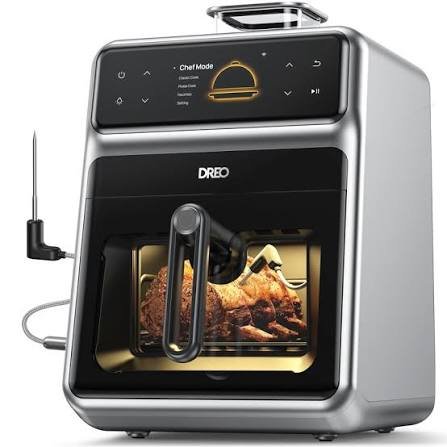
Suits cooks who want the machine to manage doneness. It is a 6 qt (5.7 L) combi fryer at 1,800 W that comes with a meat probe.
- Key features: 100–450 °F, a 200 ml water tank for steam, Chef Mode (probe plus steam, dry heat and an algorithm), classic and probe modes, a glass basket, app control and dishwasher-safe parts. The UK price was around £359.
- Advantages: Novice-friendly for steak, chicken and fish, with fast cooking and a good amount of cooking surface.
- Limitations: Premium price, runs hot, small fan-speed range, a learning curve and steam refills.
- My experience: The probe is the big win. It tracks the centre of the cut instead of trusting a timer, but position it correctly and follow the manual.
- Best for: Steak, chops and roast cuts with probe-guided results.
Ninja Foodi MAX Health Grill & Air Fryer DG551ME
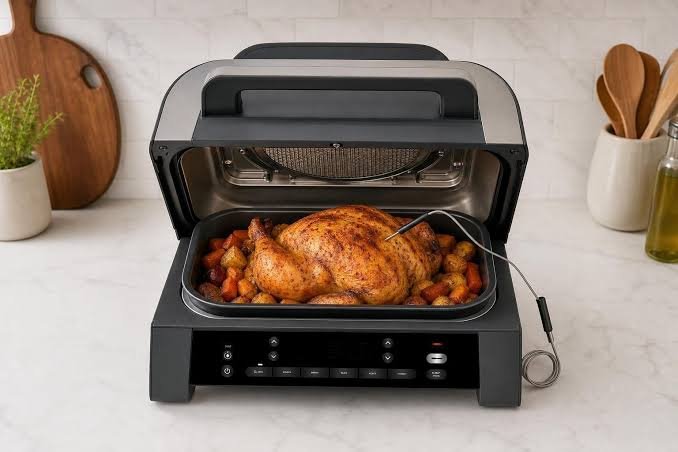
Suits small households that want grill-style steak, chops and burgers indoors. It is a lidded grill and air-fry combo with a 3.8 L pot and basket.
- Verification note: I could not find the exact DG551ME code. Details come from the related AG551 and DG551UK models, so confirm voltage, plug and warranty with your seller.
- Key features: Six functions (grill, air fry, bake, roast, reheat, dehydrate), a built-in temperature probe, Smart Cook System, a grill plate, ceramic-coated dishwasher-safe parts and about 2,460 W. The UK AG551 reaches 260 °C with a 2-year guarantee.
- Advantages: The probe and grill plate suit steak, chops and burgers. Low smoke, and the basket is ample for a family of four.
- Limitations: Small for larger families, wide and deep, and the surfaces get hot. Not a drawer-style design.
- My experience: It behaves like an indoor grill that also air fries, so think about batch size before buying.
- Best for: Couples and small families who want grill marks and probe-guided doneness.
How Do These Eight Air Fryers Compare for Meat?
The main trade-off is capacity and flexibility against precision and price. Large baskets and ovens win on volume, while probe models win on doneness control.
| Model | Type and capacity | Power and key tech | Main trade-off | Best for | Price tier* |
|---|---|---|---|---|---|
| Tefal Easy Fry Mega | Single basket, 7.5 L | ~1,700–2,020 W; 80–200 °C | Single zone; no probe | Budget families | Budget to mid |
| Breville BOV900BSS | Oven-style, 1 cu ft | 1,800 W; 13 functions; two racks | Large, costly | Roasts, one-appliance kitchens | Premium |
| Instant Vortex Plus | Single basket, 6 qt | 1,700 W; EvenCrisp | Bulky; no probe | First-time buyers | Mid |
| Philips XXL HD9870 | Single basket, 7.3 L | ~2,225 W; Smart Sensing | Availability varies | Preset lovers | Mid to high |
| Philips 5000 NA555/09 | Dual basket, ~9 L | 2,750 W; steam; sync finish | Large; high power | Full family meals | Premium |
| Typhur Dome 2 | Wide basket, 5.6 qt | 1,750 W; top and bottom heat | Slow preheat | Steak, chops, thighs | Premium |
| Dreo ChefMaker | Single basket, 6 qt | 1,800 W; probe; steam | Runs hot | Doneness-focused cooks | Premium |
| Ninja Foodi MAX DG551ME | Grill + air fryer, 3.8 L | ~2,460 W; probe; grill plate | Small capacity | Couples, small families | Mid to premium |
*Price tiers are relative to this list. Prices change often, and Black Friday and Cyber Monday sales can cut premium models noticeably, so compare current deals and warranty before buying. DG551ME specs come from the related AG551 and DG551UK models.
Other brands like Cosori, Chefman, Gourmia and Emeril Lagasse also make popular units. Confirm the current models and specs before choosing one.
How an Air Fryer Cooks Meat
An air fryer is a small convection oven with a strong fan and a powerful heating element. Rapid air technology moves hot air around the food, dries the surface and triggers the Maillard reaction, the browning that creates crust, caramelization and savory flavor.
That is why chicken skin turns crispy and burgers brown without a pan, and why lean meat can turn dry and tough if left in too long. Two things decide results: how freely air moves around the meat, and how accurately the machine holds its temperature.
What to Look For in an Air Fryer for Meat
Meat drips fat, needs precise doneness and is often bulky. I give more weight to usable cooking area and temperature checking than to the number of presets. A generous quart rating still feels cramped once you add several chops.
A wide cooking surface. Air-fried food cooks best in a single layer. Width matters more than height, so a wide, shallow basket beats a tall, narrow one or stacked racks of the same stated capacity.
Enough power. Look for roughly 1,400–1,800 watts (1700W and 1800W are common). More power means quicker recovery after you open the basket to flip a steak.
Temperature range and accuracy. A top setting near 400 °F (200 °C) crisps skin and browns crusts, and some models reach 450 °F (230 °C). Cheap units can run hotter or cooler than the dial says.
A probe or separate thermometer. A built-in meat probe cooks to temperature instead of time. Without one, a basic instant-read meat thermometer works. Color is not a reliable guide to doneness.
Drip management and cleaning. A drip tray or removable rack keeps meat out of its fat and reduces smoke. Dishwasher-safe parts and a removable crisper plate matter once you cook bacon, wings or sausage weekly.
Features worth skipping: dozens of presets you will not use, app control that does nothing for browning, and extra racks that crowd food.
Quick checklist: wide surface, 1,500 W or more, about 400 °F maximum, probe or thermometer, dishwasher-safe parts.
Air Fryer Types Compared
| Type | Best for | Strengths | Trade-offs |
|---|---|---|---|
| Single basket | 1–3 people; wings, thighs, burgers, chops | Quick preheat, compact, affordable | Crowds easily; one temperature |
| Dual basket / dual zone | Families; two meats or meat plus sides | Separate settings; sync finish | Bigger, pricier |
| Oven-style (toaster oven) | Whole chickens, roasts, ribs; some have rotisserie | Racks, more volume | Slower to heat; heavier |
| Multicooker lid | Pressure-cooker owners on a budget | Saves space | Weaker airflow, smaller |
| Combi (steam) | Mixed cooking | Flexible | Browning varies |
Basket-style air fryers generally give the best air-frying results, while an air fryer with rotisserie or an air fryer oven is better when you need height for a whole bird. Choose a basket model for everyday steak, thighs and chops, and an oven-style model only if you routinely cook whole chickens or large roasts.
The Best Air Fryer for Each Type of Meat
| Meat | Best fit | Why |
|---|---|---|
| Chicken breast | Basket with probe | Lean meat dries fast |
| Chicken thighs, wings, drumsticks | Any good basket or dual zone | Skin crisps in tight airflow |
| Steak (ribeye, sirloin, filet mignon) | Wide basket or oven-style | Needs high heat and space |
| Pork chops and tenderloin | Basket | Even heat avoids dry edges |
| Ribs and pork belly | Oven-style or large basket | Need room; fat drains |
| Burgers, meatballs, hot dogs, sausage | Any basket | Fat drains; cooks fast |
| Bacon | Basket with rack and clean tray | Watch for smoke |
| Whole chicken, turkey breast, meatloaf | Oven-style or very large basket | Height and airflow |
| Salmon, shrimp, fish fillets | Any basket | Cook fast; check early |
| Lamb chops, kebabs | Wide basket | Single layer, quick cook |
Steak. A thick steak does well in an air fryer, though it will not match a ripping-hot cast-iron sear. Pat it dry and oil it lightly. For thick ribeye or sirloin, try a reverse sear: cook until about 10 °F (5–6 °C) below target, rest briefly, then blast at maximum heat for a minute or two. Marinated or frozen meat needs extra care: pat marinated meat dry, and thaw frozen steak first for even results.
Chicken. Chicken breast is fast and consistent but dries out, so use a thermometer. Bone-in thighs are more forgiving than boneless because the fat and skin tolerate heat. For whole chicken, overfilling stops airflow and the bird steams instead of roasts, so cut it into pieces or use an oven-style unit with a rack or rotisserie.
Pork, ribs and belly. Pork belly works well because fat drains while the skin crisps. Cut ribs into short sections or use an oven-style model.
Bacon, burgers and sausage. Bacon cooks fast but the grease can smoke. Use a clean tray, a lower temperature and watch it. For burgers, 80/20 beef stays juicier, and a shallow dent in the center prevents puffing.
How Big an Air Fryer Do You Need?
Capacity is where most people go wrong, because meat needs space around it.
| Household | Typical size (qt) | Typical size (litres) |
|---|---|---|
| 1–2 people | 3–5 qt | about 3–5 L |
| 3–4 people | 5–8 qt | about 5–8 L, or dual basket |
| 5+ or meal prep | 8–10+ qt | about 8–10+ L, dual basket or 26 qt oven |
One US quart is roughly 0.95 litres. If you often cook for guests, buy one size up, since cooking in two batches is where meat goes cold and dry.
Safe Internal Temperatures for Air-Fried Meat
USDA safe temperature guidance sets these minimums, measured at the thickest part:
| Meat | Minimum internal temperature |
|---|---|
| Chicken, turkey, poultry | 165 °F (74 °C) |
| Ground beef, pork, lamb | 160 °F (71 °C) |
| Steaks, chops, roasts | 145 °F (63 °C), then rest 3 minutes |
| Fish | 145 °F (63 °C) |
A dark crust does not prove the middle is done, so always check the center. If you prefer medium rare steak below the USDA figure, that is a personal risk decision. Whole cuts carry less surface risk than ground meat, but poultry must always reach 165 °F.
How to Cook Meat in an Air Fryer: Step by Step
- Thaw fully unless the package says it can be cooked from frozen.
- Pat the surface dry. Moisture blocks browning.
- Season and add a thin coat of oil (olive oil spray or avocado oil).
- Preheat for a few minutes if your manual says so.
- Arrange in a single layer with gaps for airflow.
- Flip once about halfway, or shake smaller pieces.
- Check the internal temperature with a probe or instant-read thermometer.
- Rest the meat for a few minutes so juices redistribute.
Times vary with thickness, starting temperature and the machine, so treat recipe times as estimates and start checking early. Keep notes on what works in your own appliance, and use internal temperature, not the timer, as the final check.
Why Your Air-Fried Meat Turns Out Dry, Pale or Smoky
- Dry or rubbery: You cooked by time, not temperature, or the cut was very lean. Pull it slightly early, since it keeps cooking as it rests.
- Pale or grey, no sear: The basket was crowded, the surface wet or the machine not preheated. Dry the meat and cook in batches.
- Smoky: Fat is hitting a hot tray. Clean the tray, trim fat and lower the temperature.
- Burnt outside, raw inside: The cut is too thick for the heat. Lower the temperature and cook longer.
- Burnt sauce: Sugary marinades scorch. Brush glazes on in the last few minutes.
- Uneven cooking: Pieces overlap or vary in thickness. Space them out and group similar sizes.
Air Fryer vs Grill, Oven, Pan Sear, Smoker and Pressure Cooker
An air fryer is faster than a conventional oven and keeps the kitchen cooler, and it suits apartments and small kitchens. A grill or hot skillet gives a deeper sear and real grill marks, while a smoker wins for smoky flavor on ribs and brisket. A pressure cooker is better for tender, tough cuts. Many keto, low-carb and high-protein cooks use an air fryer for quick weeknight dinners and meal prep, and keep other tools for special jobs.
Cleaning a Greasy Air Fryer and Caring for the Coating
Meat leaves more fat drippings and burnt-on residue than fries, and old grease causes smoke and odor. Wash the basket, drip tray and rack after every fatty cook. For a sticky mess, soak in warm soapy water and degrease with a soft sponge.
Most baskets use a nonstick, PFOA-free coating, and some brands offer ceramic or stainless steel. Use non-metal utensils, avoid abrasive pads and follow your manual on aerosol sprays.
Leave clearance around the vents. Parchment paper, foil or silicone liners can help, but never cover the air intake or let paper sit loose in a preheating unit, as it can lift and touch the element.
When an Air Fryer Is Not the Right Tool
Skip it, or use another method, when:
- You are feeding a large group and need to serve everyone at once
- You want low-and-slow tenderness from tough cuts
- You want a deep, cast-iron-style steak crust
- The cut is a large roast that cannot circulate air in a small basket
Good alternatives include a convection oven, grill, cast-iron pan, sous vide finished with a sear, or a pressure cooker with an air-fry lid.
How I Evaluated These Air Fryers for Meat
I did not rank these by wattage or capacity alone. My comparison looks at:
- Usable cooking area: Can common portions sit in one layer with space for airflow?
- Doneness control: Is there a meat probe, or do you need a separate thermometer?
- Cleaning and grease: How easy are the drip tray, basket and coating to clean?
- Value: Is the price fair for the warranty, build quality and features?
Your results will still depend on meat thickness, how full the basket is, starting temperature and your particular unit.
Frequently Asked Questions
What is the best air fryer for cooking meat?
One with a wide basket, 1,500 W or more, a top temperature near 400 °F and a probe or thermometer. Pick by household size and meat type.
Can you cook steak in an air fryer?
Yes. Pat it dry, oil lightly and use a reverse sear for thick cuts. The crust will be good, though not quite cast-iron level.
Is an air fryer good for chicken breast?
Yes, it is fast and consistent, but breast dries out easily. Pull it at 165 °F.
What temperature should I cook meat in an air fryer?
Usually 350–400 °F, depending on thickness. Judge doneness by internal temperature, not the setting.
How do you keep meat juicy in an air fryer?
Avoid overcooking, use a thermometer, do not crowd the basket and rest the meat before cutting.
Does an air fryer need a meat thermometer?
Not required, but strongly recommended. A built-in probe or an instant-read thermometer is the safest way to check doneness.
How do you clean a greasy air fryer?
Let it cool, then soak the basket and tray in warm soapy water and wash with a non-abrasive sponge. Clean after every fatty cook.
The Bottom Line
The best air fryer for meat has a wide basket, at least 1,500 W, a top temperature near 400 °F and a probe or instant-read thermometer. Pick by what you cook most: Tefal Easy Fry Mega for big families, Philips 5000 Series for two foods at once, Breville Smart Oven Air Fryer Pro for roasts, Typhur Dome 2 for steak, Dreo ChefMaker for probe-guided doneness, and Instant Vortex Plus for a simple first air fryer.
Cook in a single layer, check the internal temperature (165 °F for poultry, 145 °F for steaks and chops) and rest the meat before cutting.